
Selecting the right plastic resin dryers is critical for eliminating moisture-induced defects in modern polymer processing. Many factory managers face severe operational confusion due to surface silver streaks and erratic material degradation in today’s rapidly evolving Resin Dryer Market. This comprehensive expert guide delivers technical sizing equations, dew-point insights, and temperature benchmarks to help you select the ideal auxiliary hardware and maximize your production yield.
Decoding the Resin Dryer Market: Trends and Technology Shifts
Navigating the expansive choices within the Resin Dryer Market requires a sharp alignment with today’s strict global efficiency mandates. According to the Plastics Industry Association (PLASTICS) 2025 energy-efficiency indices, upgrading to modern smart auxiliary drying systems can slash corporate plant floor energy overheads by up to 40%.
To make a profitable purchase, processing plants must calculate the relationship between resin throughput and active drying capacity. Sizing a hopper incorrectly will immediately cause downstream material starvation or severe thermal overheating.
[Hopper Selection Matrix] Required Capacity (L) = Extruder/Molder Throughput (kg/hr) × Resin Residence Time (hr) ÷ Resin Bulk Density (kg/L)
For instance, when processing technical resins at 200 kg/hr with a strict 4-hour preheat specification, your facility needs an active hopper capacity of at least 500 liters. Equipment suppliers like LD Machinery integrate real-time weight sensors to handle these flow rates automatically.
Temperature Control: Mastering PETG Drying Temperature for Flawless Molding
Once proper equipment sizing is established, mastering your precise thermal processing parameters like the PETG Drying Temperature is what ensures physical profile integrity. Engineering resins are highly hygroscopic, absorbing ambient moisture deep into their molecular chains.
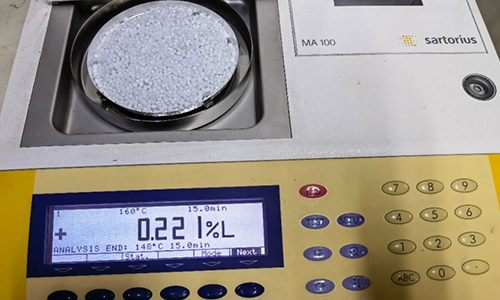
If raw materials enter the processing barrel with a moisture level above 0.02%, severe hydrolytic degradation occurs during the melting phase. According to the Society of Plastics Engineers (SPE) processing data handbook, this chemical chain degradation slashes final impact strength by 50%.
PETG Operating Processing Guidelines: | | * Critical Target Moisture: ≤ 0.02% | | * Recommended Drying Zone: 65°C – 75°C (149°F – 167°F) | | * Required Air Residence Time: 4 – 5 Hours
To avoid sticky pellet agglomeration inside your hopper, the thermal distribution profile must be strictly managed. If the temperature spikes even 5°C past the glass transition boundary, the resin will clump together into a solid mass and block the feed throat.
Deep Dehumidification: Benefits of a Desiccant Dryer For Plastic Resin
While precise heating addresses simple thermal properties, true structural stabilization requires installing an advanced Desiccant Dryer For Plastic Resin. Standard hot-air hoppers fail during humid seasons because they only warm the pellet surfaces without altering the moisture ratio of the surrounding air.
Advanced honeycomb matrix dehumidifiers overcome this by supplying a continuous, closed-loop dry air stream holding a steady -40°C dew point. This dry environment forces internal moisture out of the resin core through vapor pressure differentials.
-
Eradicating Surface Flaws: Dry air fields completely eradicate cosmetic blemishes like silver streaks and surface bubbles.
-
Maximizing Structural Yield: Deep moisture extraction stabilizes your material viscosity and eliminates structural micro-voids.
Consider this real-world application case from a medical-grade packaging facility in Indiana. After upgrading from basic hot air heaters to an LD Machinery desiccant dehumidifier system, their structural reject rates instantly dropped from 3.8% down to 0.4%, giving them full equipment ROI in six months.
Comparison Table: Hot Air Dryers vs. Desiccant Dryers for Industrial Resin
| Performance Metrics | Standard Hot Air Dryer | Desiccant Dehumidifier | Infrared Rotary Dryer |
|---|---|---|---|
| Achievable Air Dew Point | No dew point control | Steady -40°C to -50°C | Steady -40°C |
| Drying Time (PETG / Nylon) | 4 to 6 Hours (Surface only) | 3 to 4 Hours (Deep dry) | 20 to 45 Minutes |
| Energy Consumption Rate | High (Continuous heating) | Moderate (Optimized cycles) | 45% Lower than desiccant |
| Primary Material Use | Non-hygroscopic polymers | Premium engineering resins | High-efficiency crystallization |
FAQ — Frequently Asked Questions
Q What is the optimal PETG drying temperature to ensure clear molding results?
The optimal PETG drying temperature is between 65°C and 75°C (149°F to 167°F) for 4 to 5 hours. Maintaining this narrow thermal window prevents hydrolytic degradation, ensures raw crystal clarity, and prevents pellets from clumping or melting together inside the hopper feed throat.
Q Why do standard hot air plastic resin dryers fail during highly humid seasons?
Standard hot air dryers fail because they cannot lower the air’s dew point. They only heat ambient air and pass it over the material surface. In high humidity, this process cannot extract trapped internal moisture, leading to bubbles and silver streaks during extrusion.
Q When should you upgrade from a standard hopper heater to a desiccant dryer for plastic resin?
You should upgrade when processing hygroscopic engineering polymers like PETG, Nylon, or PC, and experiencing persistent visual silver streaks or brittle failures. Standard heaters cannot remove core moisture from these resins, whereas desiccant dryers provide a deep -40°C dew-point stream to ensure stable molding.
Conclusion
Choosing the correct setup from the diverse Resin Dryer Market forms the foundation of high-quality, defect-free polymer processing. By investing in a high-performance desiccant dryer for plastic resin and closely monitoring variables like the PETG drying temperature, plants can secure long-term operational consistency.
Want to optimize your materials handling and request a tailored quotation?
Post time: Jun-24-2026